
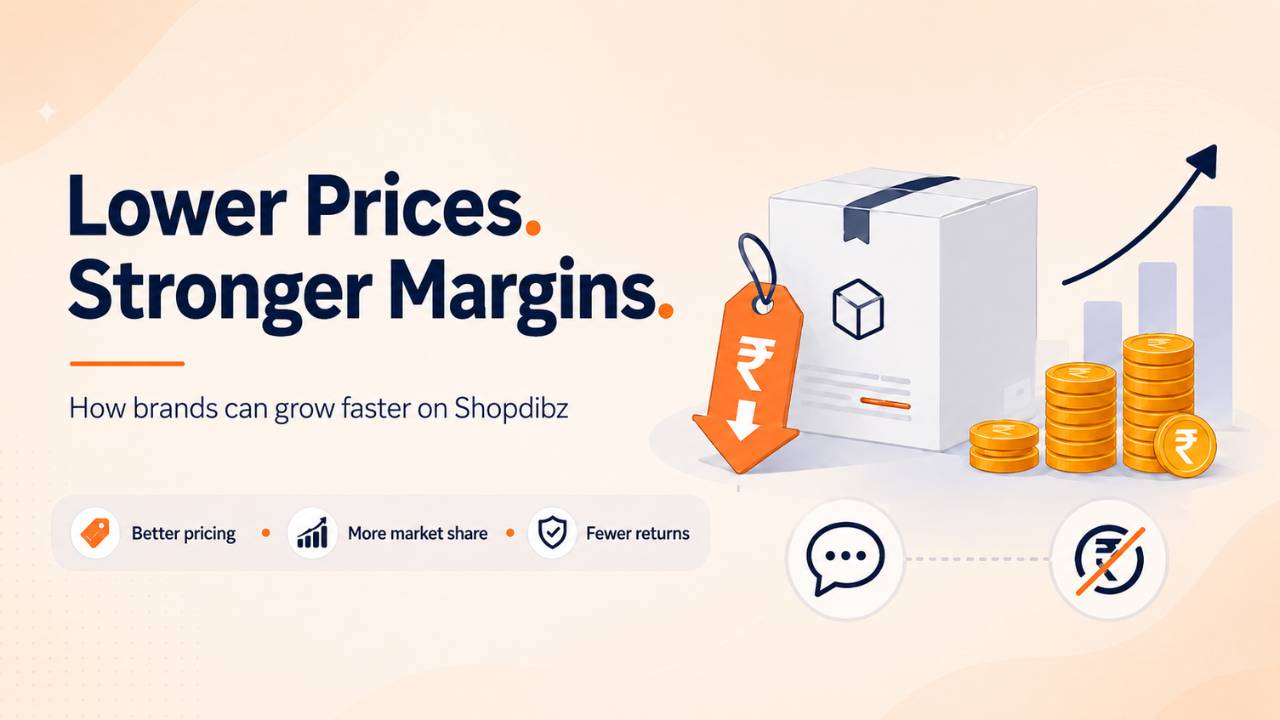
Lower Prices, Stronger Margins: How Brands Can Grow Faster on Shopdibz
For many Indian brands, lowering a product’s selling price may sound like sacrificing profit. However, pricing a product lower on Shopdibz than on other marketplaces does not necessarily mean reducing your margin.
The reason is simple: the cost of selling is different.
Lower marketplace costs create pricing flexibility
Large marketplaces may deduct multiple charges from every order, including commission, fixed fees, collection fees, shipping charges and other service costs. Brands often increase their selling price to cover these expenses.
Shopdibz follows a lower-cost seller model, with commission starting from 0% and going up to a maximum of 4.5%, depending on the category and store level. This gives brands more freedom to offer customers a better price while retaining a healthy amount from each sale.
For example, a product listed at ₹1,000 on another marketplace may be offered at ₹949 or ₹899 on Shopdibz. The customer sees a meaningful saving, while the brand may still retain a similar—or even better—margin because the marketplace deductions are lower.
Brands should calculate their complete cost per order, including product cost, packaging, shipping, payment charges and expected return costs, before deciding the final Shopdibz price.
Better prices can help brands gain market share
Indian customers compare prices before purchasing, especially when they are discovering an unfamiliar brand. A competitive Shopdibz-exclusive price can encourage customers to try the brand for the first time.
Once customers experience the product quality, packaging and service, the brand has an opportunity to turn them into repeat buyers.
Brands can strengthen this strategy by:
Creating Shopdibz-exclusive introductory prices.
Offering product bundles instead of heavy discounts.
Giving better value on selected bestsellers.
Keeping product information and stock updated.
Using their Shopdibz storefront to communicate their brand story.
The aim should not be to become the cheapest brand. The aim is to provide better value while protecting profitability.
Use brand chat to reduce avoidable returns
Returns often happen because customers are unsure about size, colour, material, compatibility or product usage. Shopdibz allows customers to chat directly with brands before placing an order.
Brands should use chat to answer practical questions quickly. For clothing, ask for the customer’s measurements and recommend the correct size. For beauty products, explain the ingredients, usage and suitable skin or hair type. For home products, confirm dimensions, colours and materials.
Clear product photographs, accurate measurements, realistic colour information, detailed size guides and easy-to-understand descriptions can further reduce confusion.
Brands can also contact customers through the available communication flow when an order has a possible issue, such as an unavailable variant or dispatch delay. Resolving the concern before shipping can prevent cancellations and returns later.
Turn returns into exchanges and learning
When appropriate, brands should recommend a size or variant exchange instead of losing the complete sale. They should also record why products are returned.
If several customers report the same sizing issue, the size chart may need correction. If customers expected a different material or colour, the photographs and description may need improvement.
Every return reason is useful customer feedback.
With competitive pricing, direct conversations, accurate listings and responsive service, brands can use Shopdibz not only as another sales channel, but as a platform to build trust, gain new customers and grow long-term market share.